Why Your Water Bill Is the First Place a Leak Shows Up
Hidden leaks don't announce themselves — they accumulate. A slab supply line losing 80 gallons a day adds roughly $100 to your annual water bill at average US rates. A failed toilet flapper losing 200 gallons a day adds $250. An underground service line break losing 500 gallons a day can add $750 or more.
The bill is a lagging indicator: by the time you notice the increase, the leak has typically been active for a billing cycle or more. But the bill pattern gives you clues. A sudden, large increase suggests a high-flow event — service line failure or a running toilet. A gradual month-over-month creep suggests a slow, continuous leak like a slab pinhole or a dripping irrigation valve.
The 7 Most Common Hidden Leak Scenarios
These are ordered by how common they are and how quickly the bill impact becomes noticeable:
- 1. Running toilet (silent flapper failure) — The most common hidden leak in any home. A failed flapper allows tank water to run continuously into the bowl — 20 to 200 gallons per day without making any sound. Easy to test: add food coloring to the tank. If color appears in the bowl within 15 minutes without flushing, the flapper is leaking. Fix is a $5 to $15 part.
- 2. Slab supply line (pinhole corrosion) — A copper supply line beneath the slab develops a small hole from soil contact or water chemistry corrosion. The pipe loses 50 to 150 gallons per day, all of it into the soil below the foundation. No visible surface moisture for weeks. Only visible sign early: water meter movement with all fixtures off.
- 3. Underground service line (between meter and house) — The supply pipe from the street to your home's main shutoff can develop cracks from soil movement or age. This section carries full line pressure — even a small crack loses significant water. The meter moves, but no indoor fixture is the cause. Wet spots in the yard over the line path are a late sign.
- 4. Irrigation system (stuck zone valve or broken head) — A zone valve stuck in the open position runs one or more irrigation zones continuously — 200 to 500 gallons per day or more. Often completely invisible: the water goes directly into the soil. Checking the irrigation controller for any zone running outside its scheduled times is the first diagnostic step.
- 5. Hot water recirculation line (pump valve failure) — Homes with hot water recirculation systems have a return loop that keeps hot water ready at every fixture. A failed check valve or pump bypass allows cold water to bleed into the system continuously. Water usage stays elevated 24 hours a day with no obvious source.
- 6. Pool or spa (shell crack or fitting leak) — A pool losing more than 1/4 inch per day of water after the evaporation bucket test suggests a structural or plumbing leak. Pool leaks can be among the highest-volume hidden leaks — a cracked return line can lose hundreds of gallons per day. Pool leak detection is a specialized discipline.
- 7. Water softener (stuck regeneration cycle) — A water softener that gets stuck in regeneration mode runs water continuously — 50 to 100 gallons per cycle, cycling repeatedly. This appears as a sustained usage increase with no identifiable source at any fixture. Bypass the softener and re-check the meter to confirm.
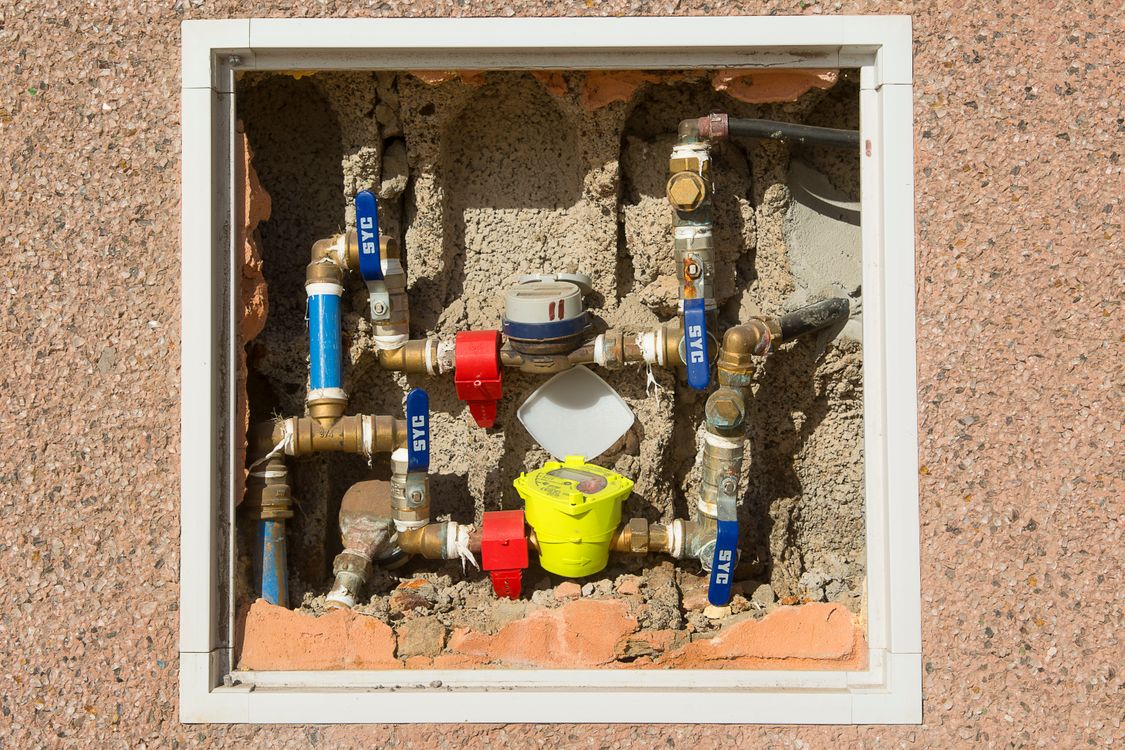
The water meter test identifies whether a leak exists and roughly how fast. But it cannot tell you which of these scenarios applies. Professional detection pinpoints the source.
How to Narrow Down the Cause
The meter test tells you a leak exists. These secondary tests help narrow the source:
Turn off the toilet supply valves one at a time, then re-check the meter — if it stops moving after isolating a specific toilet, that's your source. Turn off the irrigation controller and re-check — if meter movement stops, the irrigation system is the cause. Close the main house shutoff — if the meter continues to move with the house isolated, the leak is in the service line or outdoor plumbing, not inside the house.
These tests eliminate possibilities without any special equipment. Whatever scenario remains after basic isolation is the one a specialist should target.
When the Meter Moves but Nothing Is Found
If basic isolation tests don't identify the source and the meter continues to move, the leak is most likely underground — either a slab supply line or a service line breach. These are the scenarios that require professional acoustic or tracer gas detection. They produce no visible surface moisture, no audible running water, and no fixture behavior that identifies them — only meter movement confirms their presence.
Don't wait for visible damage before calling. By the time a slab leak produces wet flooring or a service line break produces a soggy yard, the leak has been active long enough to cause significant hidden damage.
Suspect a leak in your home? Our specialist network covers all 50 states.
(844) 485-0339 — Talk to a Specialist